Romans- chapter 7 No longer bound by the Law


The Book of Romans
Chapter 7
No longer bound by the Law
Romans 7:1 Or do you not know, brethren (for I speak to those who know the law), that the law has dominion over a man as long as he lives?
The Apostle Paul now changes his focus from that of a Gentile and Jewish mixed Christian audience to the Christian Jews specifically - to those who knew the Law, even though this letter, as a whole, was addressed to the whole Church of Jews and Gentile believers.
Many Jewish believers in Rome were still leaning on the Law of Moses and the Torah instead of trusting in the freedom that comes by grace through Jesus Christ. The apostle points out that the Law has authority over a Jew as long as he/she is alive; yet, many had yet to discover the beauty of God's grace through Jesus Christ.
To demonstrate his point more clearly, the apostle now changes his focus to marriage to re-emphasize how to be set free from the Law. Since the requirements of marriage and divorce differed somewhat between the Jews and Gentiles, the apostle found it necessary to specifically address the Jews because they would have more of an understanding of his point on how man can be free from the works of the Law.

2 For the woman who has a husband is bound by the law to her husband as long as he lives. But if the husband dies, she is released from the law of her husband. 3 So then if, while her husband lives, she marries another man, she will be called an adulteress; but if her husband dies, she is free from that law, so that she is no adulteress, though she has married another man.
According to the Law of Moses, a Jewish wife could not divorce her husband, unless in extremely rare cases. She was bound to her husband as long as she lived. She was considered like a piece of property. The husband, however, was free to divorce his wife for almost any reason. Divorce required little formality - a simple oral or written notice was sufficient.
- Among the Gentiles, however, marriage could be terminated by the woman or the man. A woman’s dowry (the daughter’s share of the parental estate) was returned to her in case of divorce. (1)
-
Marriage for Gentiles in the 1st century was little more than legalized prostitution, with divorce being an easy legal formality that could be taken advantage of as often as desired. While women were treated terribly and men used their social privileges for their own advantage, women did have more social and legal freedom.
In the extremely rare case that a Jewish woman would divorce her husband, a stigma on both parties were given by society around them and they were both shunned - considered to be in violation of the Law of Moses. If a woman did divorce her husband, she would be committing adultery if she married another man. But if her husband died, however, she is then free from that marriage and would not commit adultery when she remarried. The laws of marriage no longer applied to her.
4 Therefore, my brethren, you also have become dead to the law through the body of Christ, that you may be married to another—to Him who was raised from the dead, that we should bear fruit to God.
Making a point, the Apostle Paul was saying to these Jewish believers that they died to the power of the letter of the Law when they accepted Christ, dying with Him, so they could be married to Him - Jesus Who was raised from the dead. As such, the Law could no longer keep them bound in it so they could bear good deeds for God through Christ Jesus.
While the Apostle Paul has been addressing Jewish Christians in this section, there are definitely deep truths that speak to all Christians on the power that sin has in our life. So this is definitely not a section of Scripture to be ignored. We can then look at the Mosaic Law in the Ten Commandments as God's instruction to us - even today!
5 For when we were in the flesh, the sinful passions which were aroused by the law were at work in our members to bear fruit to death. 6 But now we have been delivered from the law, having died to what we were held by, so that we should serve in the newness of the Spirit and not in the oldness of the letter.
When we are controlled by our old nature, sinful desires are at work within us, and the Law then aroused these evil desires that produced a harvest of sinful deed, which results in death. These Jewish believers have now been released from the Law because they died to it through their faith in Christ and are no longer captive to its power. They are free to serve God, not in the old way of obeying the letter of the Law, but in the new way of living by the Holy Spirit Who dwells within them through Christ Jesus. We too, as Christians have died to the letter of the Law because Jesus Christ has set us free from the Law to serve Him in a new and better way.
Here in verse 5 we see a New Testament term "fleshly" or "carnal" that is not seen in the Old Testament. While coming from the same root in both Hebrew and Greek, the New Testament makes it more clear this is a dualistic term that separates the soul from the spirit, having a connection to the concept of human nature and its tendencies toward sin.(2)
What then is a "fleshly" or "carnal" Christian? Doing a simply AI search on the meaning, its explanation was right on," and worthy of repeating: "A carnal Christ is a believer who is saved through faith in Jesus Christ, but continues to live primarily according to their fleshly desires rather than being led by the Holy Spirit, reflecting spiritual immaturity."
"What then are the characteristics of a "carnal" Christian?
- Spiritual immature, remaining at a "milk" stage of faith, unable to engage with deeper biblial truths or spiritual disciplines,
- Has worldly priorities, conforming to cultural patterns or sinful behavior rather than God's command,
- Involved in strife and division - engaging in jealousy, pride, or quarrels with other believers,
- Lack the fruit of the Spirit - displaying works of the flesh such as selfish ambition, anger, or envy instead of love, patience, self-control - the nine fruit of the Spirit.
- Resistance to correction - Habitually yielding to sin without repentance or dependence on the Holy Spirit."
Here is where each of us as Christians need to examine our own heart regularly to see if we have any "fleshly" or "carnality" operating in our own life. If, through prayer, asking the Holy Spirit to reveal anything, this is the time to repent and ask the Lord to change our heart to be obedient in what He shows us.
When a person truly comes to trust in Christ, the natural response of a new believer is to surrender to Christ all that he or she was aware of at the time. But as we grow in our faith, our hearts become softened to the things of the Lord. As such, we discover previously hidden portions of ourselves - areas of sin we were formerly unaware of, which we then must then surrender to the Lord as well. That is what Romans - chapter 7 is all about - even for us believers today.
7 What shall we say then? Is the law sin? Certainly not! On the contrary, I would not have known sin except through the law. For I would not have known covetousness unless the law had said, “You shall not covet.” 8 But sin, taking opportunity by the commandment, produced in me all manner of evil desire. For apart from the law sin was dead. 9 I was alive once without the law, but when the commandment came, sin revived and I died. 10 And the commandment, which was to bring life, I found to bring death. 11 For sin, taking occasion by the commandment, deceived me, and by it killed me. 12 Therefore the law is holy, and the commandment holy and just and good.
Well then, the apostle writes, am I suggesting that the Law is now sinful? Heaven forbid! In fact, the Law was our teacher showing us our sin. We would never have known that greed was a sin if the Law had not said, “You must not covet.” But sin used this command of the Law to arouse all kinds of greedy desires within us! If there was no law, sin would not have that kind of power.
At one time, he continues, we lived without understanding the Law. But when we learned the command of the Law not to covet, the power of sin took control within me, and it led to death. So I discovered that the law’s commands, which were supposed to bring life, brought spiritual death instead. Sin took advantage of those commands and deceived me; it used the commands to kill me. But still, the Law itself is holy, and its commands are holy and right and good.
The Law cannot save us from sin
13 Has then what is good become death to me? Certainly not! But sin, that it might appear sin, was producing death in me through what is good, so that sin through the commandment might become exceedingly sinful.
While the Apostle Paul had a high regard for the Mosaic Law, he was desperately trying to convey the importance that faith in Jesus Christ has set us free from the letter of the Law.
But how can that be, he asks? Did the Law, which taught us God's ways, which really is good, cause my death? Of course not! Sin used what was good to bring about my condemnation which leads to death. This points out how terrible sin really is. It uses God’s good commands for its own evil purposes.
14 For we know that the law is spiritual, but I am carnal, sold under sin. 15 For what I am doing, I do not understand. For what I will to do, that I do not practice; but what I hate, that I do. 16 If, then, I do what I will not to do, I agree with the law that it is good. 17 But now, it is no longer I who do it, but sin that dwells in me. 18 For I know that in me (that is, in my flesh) nothing good dwells; for to will is present with me, but how to perform what is good I do not find. 19 For the good that I will to do, I do not do; but the evil I will not to do, that I practice. 20 Now if I do what I will not to do, it is no longer I who do it, but sin that dwells in me.
So then, the trouble is not with the Law, for it is spiritual and good. The trouble is with me, which I do not understand my behavior, for I am all too human, and a slave to sin. I want to do what is right, but I don’t do it. Instead, I do that very thing that I hate. Yet, I know that what I am doing is wrong, and it shows me that the Law is good. So if I do what I will not to do, it is no longer I who does it, but the sin that lives with me.
21 I find then a law, that evil is present with me, the one who wills to do good. 22 For I delight in the law of God according to the inward man. 23 But I see another law in my members, warring against the law of my mind, and bringing me into captivity to the law of sin which is in my members. 24 O wretched man that I am! Who will deliver me from this body of death? 25 I thank God—through Jesus Christ our Lord! So then, with the mind I myself serve the law of God, but with the flesh the law of sin.
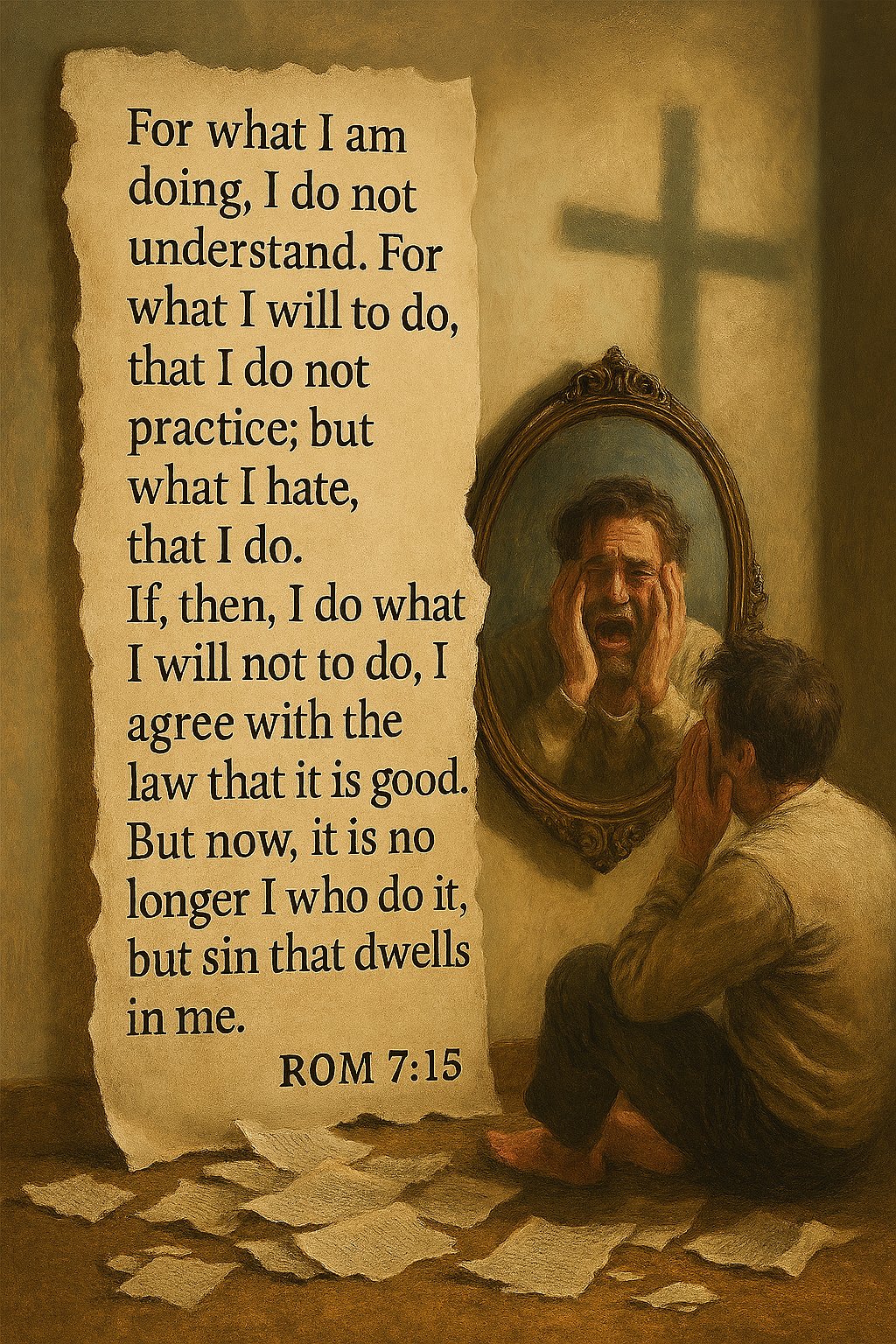
In conclusion, the New Living Translation explains these last few verses very well. "I have discovered this principle of life—that when I want to do what is right, I inevitably do what is wrong. I love God’s law with all my heart. But there is another power within me that is at war with my mind. This power makes me a slave to the sin that is still within me. Oh, what a miserable person I am! Who will free me from this life that is dominated by sin and death? Thank God! The answer is in Jesus Christ our Lord. So you see how it is: In my mind I really want to obey God’s law, but because of my sinful nature I am a slave to sin."
This is so true of all believers. Our heart wants to do right with God, but sin has such a tight grip on all of us. That is why we should be so grateful for what Jesus did for us, and that He gave us the power of His Holy Spirit to be planted within us to empower us to overcome that sinful nature. As such, we no longer have to be slaves to the sins that so greatly besets us.
Romans - chapter 8 gives us the answers to how to overcome sin!
"Thank You Jesus!"
(1) A Woman’s Place in the First Century
(2) Jewish New Testament Commentary - David Sterns


Written by Pastor Joyce A. Erickson
Believers Bible School, Founder https://believersbibleschool.com/