Romans - Introduction The background history of the Apostle Paul's ministry in Rome and an understanding of the earliest churches in that city


The Epistle of Paul to the Romans
Introduction
As we begin our study in the Epistles of Romans, let me preface by saying that I have taught on this book of the Bible more times that I can count on over the decades. Each time, however, when I do a new study on any topic or book of the Bible, even on a teachings I have taught on many times, I never teach from the same notes as before. I always start over from scratch, and when I have done all my research and written down what I have learned, I then will go back to my old notes to see if I have included everything I wanted to write or say. Every time, without fail, I discover that I keep learning new things as I study what I am about to teach. You see, there is no depths so deep that God can't teach us more of His Word. In the case of the Epistle of Romans, it is most definitely true. So if you have been a student of mine over the years, having studies on the Book of Romans, be rest assured that new information is included as I have grown in my knowledge and wisdom of the Word of God. The Book of Romans is one of those books of the Bible that we keep learning and gleaning new truths as God shows us His goodness and grace toward us. So please join me as we study the Epistle of Romans.

DATE AND PLACE OF WRITING
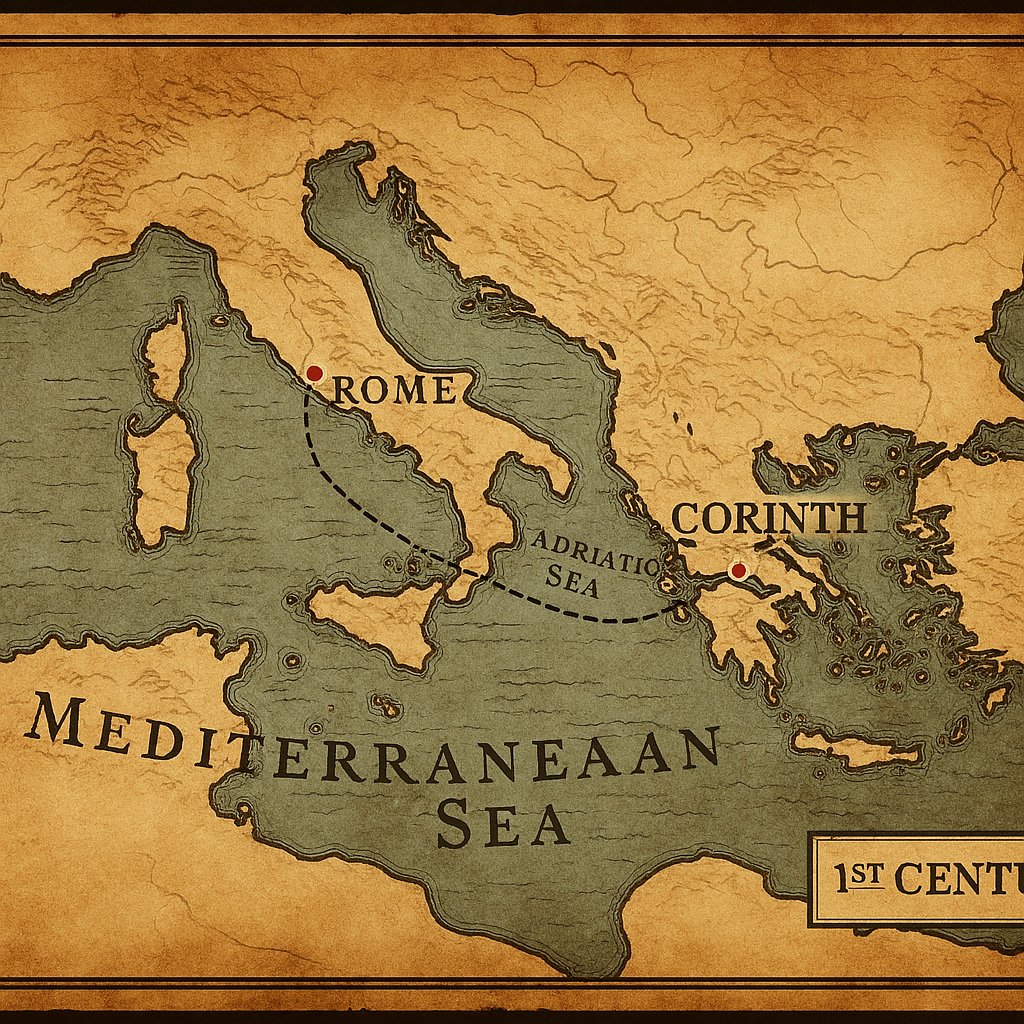
The year was somewhere between 57-58 A.D., some twenty-five years after the crucifixion of Jesus Christ. The Apostle Paul was at the end of his third missionary journey for Christ when he wrote this letter to the churches (plural) in Rome from Corinth, which is a ithmus land mass connected to Athens, Greece. While the apostle dictated the letter, it was penned by a ministry partner named Tertius, according to the salutation in Romans 16:22.
Tertius was a Christian from Rome who was now living in Corinth. He was numbered as one of the 70 disciples who followed Jesus, and the apostle had met him on one of his missionary journeys. Tertius was well acquainted with many Roman Christians in Rome and would be in a position to help the apostle greatly in his writings to the Christians in Rome. Because of Tertius' influence, it opened the door for the Apostle Paul to write this awesome letter that would one day influence millions of people.
The Apostle Paul had recently finished his second letter to the Corinthians, and he felt he needed to write a letter to the churches in Rome, which consisted mainly of Gentile believers, of which many were slaves, with a few Messianic believers.
While the apostle had never been to Rome at this point, many were likely converts from other cities whom Paul had led to faith and who had brought their faith to Rome. Christianity was florishing in Rome, the principal city of the world at that point, and they needed solid teachings of the Truths of the Word of God. The Roman churches were in a position of setting an example of Christianity to the rest of the known world.
The Apostle Paul's intentions were to stop off briefly in Rome after his stay in Corinth and then travel on to Spain - being considered the end of the world. Since his purpose was only to minister in uncharted territory to the Gentiles, knowing there were several disciples in Rome, he had no intention of staying there. Before he went there, however, he wanted to revisit the "poor" churches at Jerusalem with a collection of money he had previously gathered from Macedonia and Achaia. Little did the apostle know that he would be coming to Italy not out of choice, but in chains.
According to Romans 16:1 there was a business woman named Phoebe who was also the deaconess’ at the church at Cenchrea-Corinth, and who was sailing to Rome come spring. She was preparing to sail from Corinth to Rome on business, so this was the perfect opportunity for her to carry Paul's letter to the Roman churches, delivering them personally to one of the head churches, which in turn would then share the letter with other Christian churches throughout Rome.
Rome was the capital of the known world during the 1st century A.D. The population was over one million at that time. Nero was the emperor at that time; however, in his early years of reign, he was more tolerant toward Christians. Within a few short years, however, he would change and turn against the Christians not only in Rome, but throughout the empire.

The Roman world was primarily a Hellenistic world, having the Greek language as the spoken language of the people, filled with Roman/Greco gods - hundreds of them to worship. Rome was the political headquarters of the Roman world where all political decisions came from. Its politcal leaders saw that religion was important to the people, so they initiated emperor worship, which by the 1st century A,D., it was the norm of society throughout its capital city. Statues of the emperors were placed amongst the other pagan deities. Religion, however, had nothing to do with the morals or ethics of society.
Rome was a sexual morally debased city, filled with adultery and fornication, and homosexuality was openly accepted. Rome was the leader in the debasement of the sexual and moral society throughout the empire. Temple prostitution was part of some religious cultic activity and accepted as part of society.
The human worth of man was at a low in Rome throughout the 1st century A.D. Unwanted babies, especially girls, were put on garbge piles or left in some isolated area to die. Some picked them up to be raised as slaves or prostitutes. Work was limited for non-slaves because the wealthy owned most of the slaves who did the work. As a result, it was very difficult for the average person to earn a wage.
Traditions regarding the Church in Rome
There are traditions stating the Apostle Peter started the Church at Rome; however, there is no biblical proof of this ever happening. Here is what we know from Scripture:
The church at Rome consisted of several small church around 57/58 A.D. when the Apostle Paul wrote to the Roman churches. They were all house churches - very poor churches (Romans 16:5).They consisted of mostly Gentile believers with a few Jewish believers. A large portion of them were slaves.
At the time of the writings of this letter (57-58 A.D.) when the Apostle Paul wrote to the Roman believers, Rome was not the headquarters for the Church. Jerusalem was still the head church among Christianity with James, the brother of Jesus as its elder of pastor over the Christian churches (Acts 15). The Jerusalem Church, however, was declining because of persecution that had been mounting for a couple of decades. People were fleeing to other parts of the world to avoid persecution. In 62 A.D. James was martyred and Jerusalem lost its power as the head over Christianity. Because this letter was written in 57/58 A.D., we know for certain that James, the brother of Jesus, was definitely in charge over the Christian Church.
Following the martyrdom of James, the church headquarters moved to Antioch according to the Book of Acts. As persecution mounted there, the head church then moved to Ephesus at the far end of Asia Minor because most of the Christian world was there. That was also the place where the Apostle John was living and he became the head of the Church. John lived in Ephesus and remained head over the Church until he was imprisoned to the island of Patmos, just off the coast of Ephesus for his faith. After nine months he was released and returned to Ephesus and continued his ministry as head over the churches throughout Asia Minor. After John's death, Polycarp (John’s protégé) of Smyrna became to be the bishop over the churches throughout Asia Minor. Polycarp was later dragged off to Rome and martyred as head of the Church. Following Polycarp's martyrdom, the leaders of Christianity were in Rome and has remained there since - at least within Catholicism.
Throughout Paul's imprisonment in Rome, there are no writings of him every appealing to Peter (who was supposedly in Rome), which Catholic tradition state he had been the bishop of Rome since the mid 40s. Most biblical scholars do not place Peter in Rome during this time. He may have come to Rome closer to 68 A.D., wherer he was crucified upside down as a martyr for Christ.
In closing on this issue, the Scriptures make it clear tht the Apostle Peter was given the ministry of preaching to the Jews, whereas the Apostle Paul was given the ministry to the Gentiles (Gal 2:7-8). We do know that the churches in Rome consisted primarily with Gentile Christians.
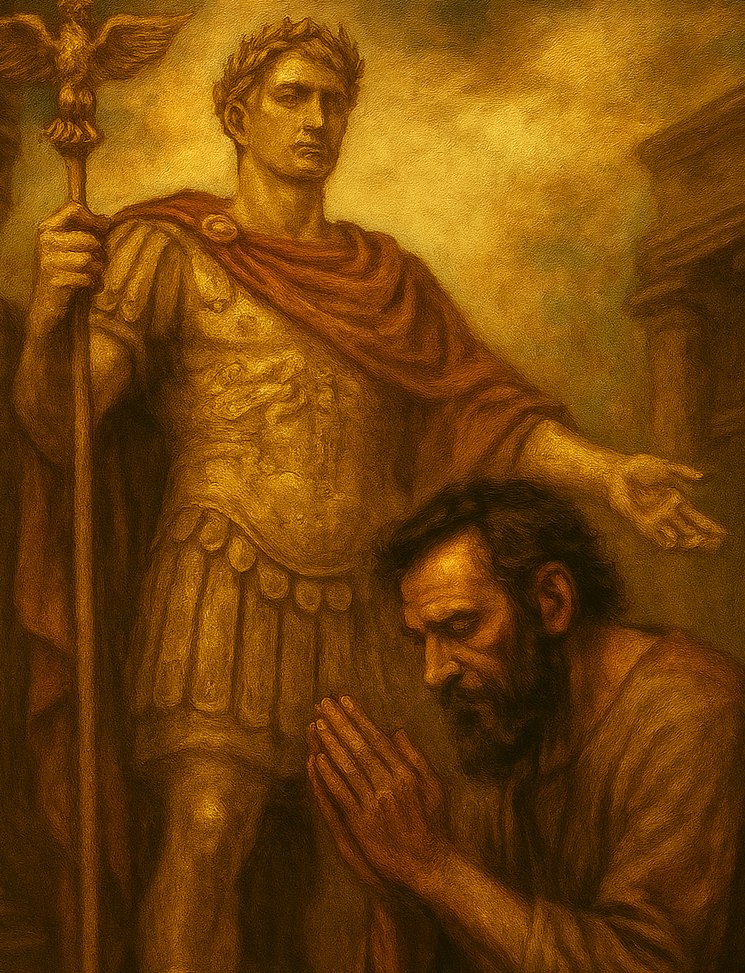
Ex 20:5-6 "You shall not make for yourself a carved image—any likeness of anything that is in heaven above, or that is in the earth beneath, or that is in the water under the earth; 5 you shall not bow down to them nor [a]serve them. For I, the Lord your God, am a jealous God, visiting[b] the iniquity of the fathers upon the children to the third and fourth generations of those who hate Me,
Christians were called atheists
Christians could not bow before anyone who claimed divine authority, including the emperor. All worship was reserved only for the Lord according to Ex 20:5-6. As such, Christians were called atheists (non-believers in the pagan gods) and considered enemies of the state. The pagan people could not understand why Christians, to avoid persecution, would not bow down to the emperor or his statues. It was simply ritualistic.
Christians were often persecuted by the state because of unwillingness to participate in rituals, religious or otherwise, or refusal to bow before the images of the emperor. Roman belief was that the pagan gods required sacrifices and other observances. If anyone refused to comply, the gods would become angry and take their wrath out on the people as a whole. A Christian’s refusal to comply meant the gods were angered at all the people.

Theme of the Epistle of Romans
The Book of Romans is one of the most profound books in the New Testament, often called "The Constitution of Christianity." It is filled with doctrine, instruction, wisdom and truth, teaching us how to live the Christian life. It is the most theological/doctrinal of all of the Apostle Paul's epistles and the longest epistle he wrote. The focus of this book is on the absolute righteousness of God. Some say that if this letter to the Romans was the only New Testament book you had, you would have all you need to lead a solid Christian life before God.
The Epistle of Romans consists of two halves - the first being doctrinal, and the second half being practical. Sandwiched in-between, the apostle explains Israekl's place in the plan of salvation and why Israel rejected Christ.
Paul’s Journey to Rome
Traveling by water could only be done certain times of the year for it was dangerous and impossible in the winter. All sailing on the waters of the Mediterranean Sea were scheduled in the warmer climate months.
We learned that in the spring following the apostle finishing this epistle, he handed it to Phoebe, his friend in the ministry who was sailing to Rome on business. As we learned in the beginning of this introduction, Paul was planning to head off to the Church at Jerusalem first to give the monies collected to the poor churches in Jerusalem and then sail off to Rome to visit the churches he was writing this letter to, but only stay briefly, as his mission was to head off to Spain, which to him was the ends of the earth. Plans, however, changed.
As Paul and his ministry team were preparing to sail for Jerusalem, a plot was forming against him by some of the religious Jews. (Acts 20-28). To avoid getting caught, Paul alone secretly boarded another ship to Athens. His ministry team boarded the designated ship to later catch up with Paul. Paul then traveled backward on another ship to catch up with his team. As Paul continued to travel, he consistently was dodging Jews who were trying to kill him. It was then that the Holy Spirit revealed to him that chains awaited him at Jerusalem.
Paul had made a commitment to go to Jerusalem to deliver the monies collected to the poor church in that city. As the ship docked temporarily in Ephesus, disciples he had ministered to in that city came to him on shored waqrning him not to go to Jerusalem, for if he did, he would surely be killed. Paul, however, insisted he had to go - for he was willing to die for the Gospel
After landing in Israel, Agabus (prophet) prophesied to Paul that chains await him. Regardless, Paul continued on to Jerusalem. When he arrived in Jerusalem, Paul met with James, the bishop/head of the Church, giving him the money he had collected in Macedonia, and sharing all that had happened for the Gospel sake. While in Jerusalem, he was accused by some infuriating Jews of bringing some of Gentile ministry team members into the temple to worship. He was seied, arrester, and thrown out of the temple - taken to a Roman prison. The Jews wanted Paul killed, but they did not have the authority to do so. Upon his arrest, Paul appealed to his Jewish and Roman heritage. When the Roman leaders could not find fault in hin, he was taken before the Jewish Sanhedrin, who wanted him dead - considering him to be a traitor. Rescued from death, but not from confinement, the Romans sent him off to Caesarea to stand before Governor Felix. There he remained in custody for two years, but was allowed visitors.
Governor Felix retired and Festus became the new governor. Festus then sent him back to Jerusalem to be judgedf by King Agrippa. Again, Paul used his Roman citizenship as his protection, appealing to stand before Augustus Caesar - the Roman emperor. So, he was sent off on a ship headed to Rome as a prisoner. Shipwrecked along the shores of Malta, everyone had to wait another three months for warmer weather to sail.
When arriving in Rome, Paul came in chains and was delivered to the captain of the guard. He then remained under house arrest with a guarded soldier for the next two years. While he couldn't leave, he set up ministry in his prison house, and had many visitors.
Click here for chapter 1

Click here to order book

Written by Pastor Joyce A. Erickson
Believers Bible School, Founder https://believersbibleschool.com/