Hebrews - Chapter 7 The High Priest Melchizedek


Background Information on Abraham, Lot, and Melchizedek

In this chapter we will learn a lot about the Old Testament Melchizedek, meaning "righteousness," who, during the time of Abraham, was the king of Salem and the high priest of El Elyon - the most high God. Much speculation has been made as to Melchizedek's identity, as well as concerted effort to link him to a New Testament Christian tithe. Both of these issues, however, are not the emphasis of this chapter, although these two issues will briefly be discussed.
"Salem" comes out of the Hebrew word "Shalem," meaning peace, health, integrity,wholeness.
"Salem" was the ancient city known today as "Jerusalem"
The Book of Genesis tells us that Abraham had so much land and cattle to where there was not enough room for him and his nephew Lot to house their livestock. Abraham chose to divide his property and give Lot half of what was his. He then gave Lot the opportunity to choose which area he wanted to live in among Abraham's vast territory. Lot chose the area close to the wicked city of Sodom as he was lured by its city life. Abraham stayed further out on the plains, in the outskirts of Hebron.
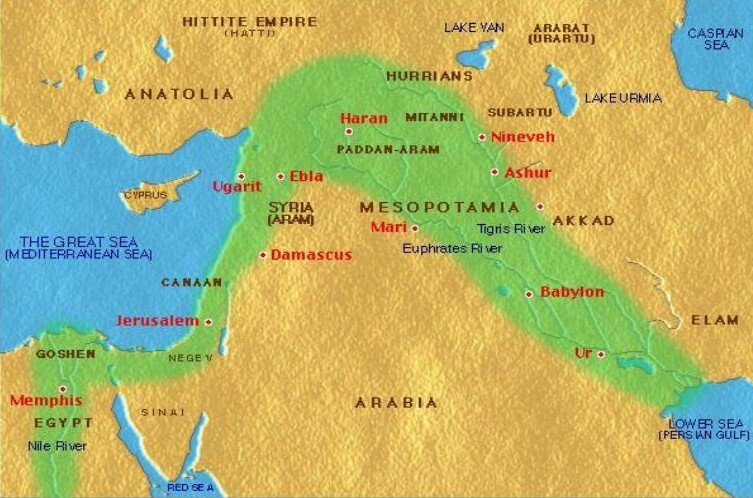
The Fertile Crescent was lush fertile soil that followed rivers in an arc that extended from Mesopotamia in the east to Egypt in the west. The land of Canaan, having the Dead Sea in its southern portion, was at the downward swing of the center point of the crescent, which marked it as a pivotal spot for travelers and trade.
The War of the Fertile Crescent
Five small city-kings from the southern end of the Dead Sea area in Canaan, which included Sodom and Gomorrah, had been conquered by several kings from the area of Mesopotamia. The defeated kings and their people were forced to serve King Chedorlaomer of Elam and pay tributes (forced taxes) to this king who resided at the west end of the Fertile Crescent.
After twelve years of forced servitude and paying tributes, the defeated kings of Sodom and Gomorrah and other nearby cities south of the Dead Sea began to rebel against their conqueror. In response, King Chedorlaomer, along with three other ruling city-state kings around the Tigris and Euphrates Rivers, traveled 700-900 miles up the Fertile Crescent to re-conquer their rebels. Along the way, they also conquered other territories adding to their booty of spoils. According to Genesis 14, they defeated and conquered the armies of these fives small city-kings at the southern end of the Dead Sea area, which included Sodom and Gomorrah, capturing many and gained great wealth from the spoils of war. King Chedorlaomer was again the conqueror. Lot, living on the edge of Sodom and Gomorrah was caught in the midst of the war with King Chedorlaomer and, as such, he, his family, and everything he owned was captured. He, along with his family, servants, and all of his cattle and possessions were taken away. The spoils of war were tremendous for King Chedorlaomer. Through an escapee, Abraham found out what had happened to his nephew Lot.
Abraham, being a man of means, took 318 of his servants, along with allied Amorite friends and pursued King Chedorlaomer and his army, defeating them just north of Damascus. Abraham was able to retrieve his nephew Lot, along with his family, servants, friends, goods and livestock. He was also able to retrieve all the people, food and goods of Sodom and Gomorrah that were taken captive. His gains of the spoils of war were tremendous.
On their return journey home, Abraham, Lot and his family, along with his 318 servants, and all the massive spoils of war, traveled back home through the Kings Valley just outside of Salem. There Abraham was greeted by the new king of Sodom and other kings of the area. Following right behind these kings was Melchizedek, king of Salem and high priest of El Elyon, the most high God, who was known for his righteousness. Melchizedek brought bread and wine to feed Abraham and the people with him, which had to be a big production. Then Melchizedek conferred a blessing upon Abraham, of which Abraham then honored him back, as was the custom of that time, even among paganism, by giving him a tenth (10%) of all the spoils of war that had been stolen from Sodom and Gomorrah and his nephew Lot. Abraham then gave back the spoils that belonged to Sodom and Gomorrah as well as everything that belonged to Lot - all less 10%, which went to King and high priest Melchizedek.
Priesthood and Tithing - Ancient Civilian Practice
The concept of the priesthood and tithing can be traced back to various ancient civilizations, where it was often intertwined with religious and societal structures. Tithing was a common practice among the Sumerians and Babylonians as a way to support their temples and priesthoods, ensuring that the gods were appeased and that the community’s spiritual leaders could perform their duties effectively. The practice was not merely a religious obligation but also a means of maintaining social order and cohesion among the people.
God often used what was familiar practices with His people to establish a practice to enter into God's ways and a way of life for God's people. The practice of the priesthood and the tithe was one of those practices in which God intertwined into the practice of their faith in Him and a way of life for God's people. Why? Because it was familiar to the people, and would be accepted by them. This then would lay the groundwork for later Jewish practices.(1)
High Priest Melchizedek
The purpose of this chapter is to show that Melchizedek was a king AND a high priest in the same way Jesus became (and is) King and High Priest to us today. God used something familiar and acceptable with His people to where they would understand and accept.
Melchizedek came on suddenly in Genesis 14 and left abruptly, establishing a pattern. It would be another 1000 years before he was mentioned again in Scripture - in Psm 110:4. In this one verse, King David mentions him as he prophsied the future Messiah would be a king and High Priest "after the order of Melchizedek." It then took another 1000 years before Melchizedek was mentioned again in scripture - here in the Epistle of Hebrews as being king and high priest along with Jesus Christ, who both of these men were king and high priest - the only ones who obtained these two titles collectively.
The first mention of any sort of tithe goes back to Genesis 14:17-20 where Abraham paid tithes to Melchizedek, which was a common practice in many cities, including pagan cities. The timing of this period was approximately 1913 B.C. - about four hundred years before the Mosaic Law.
- After Abraham brought the tithe to Melchizedek, the king of Sodom then told Abraham to keep the rest of the spoils (90%) for himself, but only return the captive people. Abraham responded by telling him that he had promised the LORD (Yahweh, Jehovah) whom he recognized as his El Elyon (Most High God) that he would not take any of the spoils, claiming he did not want the king of Sodom to boast that he had made him rich. Abraham then returned the 90% to the kings of Sodom and Gommorah, less Lot, his people and his goods. Abraham was a hero of the people and favored among the kings of their land. He then traveled south to the Dead Sea area to return back home to normal living, not taking anything back with him.
There are several important things to note from this event of Abraham giving a tithe to Melchizedek:
- This is the only mention of any “tithe” in Scripture that preceded the Law of Moses.
- This tithe to Melchizedek was an isolated one-time event. There is no other acknowledgement that Abraham ever tithed again.
- God never told Abraham to tithe to Melchizedek - it was a custom of the land at that time.
- Abraham did not tithe from his personal property, but from the spoils of war to the king of Salem and a priest at that time.
- The king of Sodom, who was a pagan king, offered the remaining 90% of the plunder for Abraham to keep for his own. Abraham, however, gave the full 90% back, except for his nephew Lot, his family, and Lot's goods to the king of Sodom, not Melchizedek.
Assumptive Understanding of Christians Today
Christians today want to use this "one-time" Old Testament example to confirm that tithing is necessary for New Testament believers to give 10% of their gain back to Jesus. We must keep in mind that Abraham gave out of the spoils of war, not his personal gain. This was the custom of that day in pagan cities to give 10% back to the king or high priest when victorious in battle. While there is no other time when Abraham gave anything else back to Melchidezek, this high priest, we have learned that this man was someone very special that God used as an example for God's people.
- The tithe, however, according to the Mosaic Law was not 10%, but 23 1/3% divided up into three separate givings.
- There is nothing listed as a New Testament tithe. There are three mentions of the Old Testament tithe that is listed under the Law and between Abraham and Melchezedek, but nothing commanding the Church to tithe.
- The Scriptures do, however, state that God owns all of us, meaning 100%, and that we are to give cheerfully back to Him, out of a willing heart, as the Lord directs each believer.
2 Corinthians 9:7 Each one should give what he has decided in his heart to give, not out of
regret or compulsion. For God loves a cheerful giver.
Each of you should give what you have decided in your heart to give,
not reluctantly or under compulsion, for God loves a cheerful giver.
Abraham gave tithes to Melchizedek, king and high priest

Having this background, let us now go on to study chapter 7 in the Epistle to the Hebrews
Hebrews 7:1 For this Melchizedek, king of Salem, priest of the Most High God, who met Abraham returning from the slaughter of the kings and blessed him, 2 to whom also Abraham gave a tenth part of all, first being translated “king of righteousness,” and then also king of Salem, meaning “king of peace,” 3 without father, without mother, without genealogy, having neither beginning of days nor end of life, but made like the Son of God, remains a priest continually.
Hebrews 7:1 For this Melchizedek, king of Salem, priest of the Most High God, who met Abraham returning from the slaughter of the kings and blessed him, 2 to whom also Abraham gave a tenth part of all, first being translated “king of righteousness,” and then also king of Salem, meaning “king of peace,”
We learn from these two verses that Melchizedek was the king of Salem and high priest of the most high God who collected tithes from the people. He was known as a king of righteousness and a king of peace. Abraham, coming back from a victorious feat over their enemy gave a tenth of his spoils to Melchizedek, which we have learned was the custom of the people at that time.
3 without father, without mother, without genealogy, having neither beginning of days nor end of life, but made like the Son of God, remains a priest continually.
Melchizedek's genealogy was not known, listing him without father or mother, not having beginning of days, nor end of life - made like the Son of God (Jesus) Who remains our High Priest forever.
- Many biblical scholars take these words literally stating that Melchizedek always was and always will be, like the Son of God Who remains our High Priest forever. There are some biblical scholars who would claim that just as Jesus, Who is God, was in on creation and will be our High Priest forever, Melchizedek may have been Jesus incarnate because there was no genealogy on record for him causing the wording having no father or mother nor beginning of days, nor end of life. In that way, Melchizedek's unknown lineage was made like the Son of God (Jesus) Who remains our High Priest forever.
- Who is Melchizedek's true identity? Scripture does not tell us for certain. This is one of those answers that remain a mystery among Jews and Christians alike even to this day.
4 Now consider how great this man was, to whom even the patriarch Abraham gave a tenth of the spoils.
The author of the Epistle of Hebrews considered Melchizedek a great man who the patriarch Abraham gave a tenth of the spoils of the victory from King Chedorlaomer who had ruled over the people of that area. Both Melchizedek and Abraham have become heroes from our ancient past.
Think about how great both Abraham and Melchizedek were to the people:
- No longer were the local kings, including Melchizedek of Salem forced to be in servanthood or pay tributes to King Chedorlaomer, causing them to now be grateful to Abraham, causing him to be a hero with the leaders of all the local cities as well as all the people who lived in those areas.
- The families of the kidnapped captives were now bringing back their loved ones, making Abraham a hero.
- Lot and his family was saved, along with all of their possessions, causing Abraham to be a hero.
- A tenth of the spoils of that victory would have been immense, which brought back a lot of wealth to Melchizedek, the king and High Priest of Salem, whose God was the Most High God El Elyon. As such, all the needs of the temple of Salem were plentiful.
Regardless of who you think Melchizedek may have been, he was a powerful and wealthy king and high priest over that area, who was kind, righteous, and a man of peace. No genealogy is listed for him, which makes him a very mysterious man, but one to be respected and honored.


The Levitical priesthood
5 And indeed those who are of the sons of Levi, who receive the priesthood, have a commandment to receive tithes from the people according to the law, that is, from their brethren, though they have come from the loins of Abraham; 6 but he whose genealogy is not derived from them received tithes from Abraham and blessed him who had the promises.
Over 400 years transpired, and the story of Abraham was passed on down from one generation to the next. Once Abraham's son Isaac was born, his continued lineage grew and all were proud to be part of the seed of Abraham. Within Abraham's loins rested twelve seeds.
Out of Abraham's seed came Isaac, then Isaac beget Jacob, and out of the family of Jacob came twelve sons - Reuben, Simeon, Levi, Judah, Issachar, Zebulun, Dan, Naphtali, Gad, Asher, Joseph (Manassah, Ephraim) and Benjamin.
God used the seed of Abraham
God used that same known principle of a priesthood and high priest with His people after they escaped from Egypt 400 years later that was used with Melchizedek and Abraham. Moses, who from the seed of Levi, was called by God to set His people free from the slavery of Egypt to go back to their Promised Land of Canaan.
- While wandering in the wilderness, Moses, being instructed by God, set up the priesthood in a way the people already understood. It included the tent tabernacle that housed the inner and outer court - the Holy of Holies where God dwelt, and the burnt altar where sacrifices were to be offered for the atonement of sins.
- Aaron, the brother of Moses, was positioned by God to be the high priest, and a priesthood was established out of the Levite tribe of Israelites. The high priest governed over the people spiritually, alongside Moses who ruled over the people in all affairs.
- While the people were required to bring animal sacrifices to the altar while wandering in the wilderness for the atonement of their sins, they were not required to pay tithes to the priesthood while they wandered in the wilderness because their was no agricultural growing in the desert and the tithes were to come out of the produce of the land.
- Once they finally arrived in Canaan, however, and were able to grow produce from their land, tithes were then required from every family. That was the law according to the Levitical Law of Moses.
7 Now beyond all contradiction the lesser is blessed by the better. 8 Here mortal men receive tithes, but there he receives them, of whom it is witnessed that he lives. 9 Even Levi, who receives tithes, paid tithes through Abraham, so to speak, 10 for he was still in the loins of his father when Melchizedek met him.
Melchidezek blessed Abraham, who was considered at that time to be greater than Abraham. God then used mortal men of the tribe of Levi to receive tithes to the one without genealogy - who continues to live.
- According to the Messianic Jewish Commentary, there appears to be an order of greatness here where Melchidezek Who was the greatest, received a tenth from Abraham who was the second greatest.
- Even after 400 years the seed of Abraham was within Aaron (the Levitical high priest), being mortal, now being the third greatest received tithes on behalf of Abraham from the Levitical priesthood, who became the fourth greatest.(2)
A Need for a New Priesthood Jesus - Our High Priest Forever

11 Therefore, if perfection were through the Levitical priesthood (for under it the people received the law), what further need was there that another priest should rise according to the order of Melchizedek, and not be called according to the order of Aaron? 12 For the priesthood being changed, of necessity there is also a change of the law. 13 For He of whom these things are spoken belongs to another tribe, from which no man has officiated at the altar.
The word "perfection" here carries the Greek meaning of "absolution, completion and perfect performance." Understanding this, how then can perfection with God come through the Levitical priesthood in the giving of the Law. It was given to mortal men and mortal man is sinful, continuously needing atoning forgiveness of sin. The Levitical Law required continuous animal sacrifice for the forgiveness of sins. Therefore, there was a need for a new priesthood, another High Priest needed to come after the order of Melchizedek - not according to the order of Aaron the high priest, who was a mortal sinful man, but a High Priest, Who has become the One sacrifice for mankind, and Who lives eternally to offer continuous forgiveness that brings of "absolution, completion and perfect performance."
- The writings of the Torah and the Prophets (Old Testament) cannot bring on the goal of man's eternal forgiveness. Simply following the Law is legalistic observance of righteousness, but does not make a person righteous in the sight of God. It simply points out how sinful man really is and that he is not not able to enter into the presence of God.
- If a new priesthood is needed, then there also needs to be a change in the law, bringing a High Priest that can eternally forgive man's sinful nature. Mankind needs to be transformed and so did the Law of Moses.
14 For it is evident that our Lord arose from Judah, of which tribe Moses spoke nothing concerning priesthood. 15 And it is yet far more evident if, in the likeness of Melchizedek, there arises another priest 16 who has come, not according to the law of a fleshly commandment, but according to the power of an endless life. 17 For He testifies “You are a priest forever According to the order of Melchizedek.”
Jesus, our Lord and Savior, arose from the Tribe of Judah through His mother Mary, who by the virgin birth was conceived by the Holy Spirit of God. Moses, however spoke nothing regarding the Tribe of Judah in connection with the priesthood. If our eternal High Priest was to come in the likeness of Melchizedek, who was without genealogy, there needed to arise another priest who would come came not according to the Law of Moses, which came through mortal sinful men, but according to the power of God that gives life forevermore. That King and High Priest then must come according to the order of Melchizedek.
18 For on the one hand there is an annulling of the former commandment because of its weakness and unprofitableness, 19 for the law made nothing perfect; on the other hand, there is the bringing in of a better hope, through which we draw near to God.
The Law of Moses was imperfect, but it was meant, as a teacher, to show God's people the bravity of their sin. As such, they continued to offer animal sacrifices for their continued sin from one generation to another. While weak and unprofitable, and certainly not perfect, we can now have hope in how we draw near to God.
A High Priest Forever
20 And inasmuch as He was not made priest without an oath 21 (for they have become priests without an oath, but He with an oath by Him who said to Him: “The Lord has sworn And will not relent, ‘You are a priest forever According to the order of Melchizedek’ ”),22 by so much more Jesus has become a surety of a better covenant.
The Levitical priesthood lived by taking oaths - promises to fulfill their duties of the Law of Moses. Many along the way, however, did not fulfill that promise. Here is a promise to us:
- God proclaimed, making an oath by Himself to Himself, meaning this is the strongest of oaths that can be made. Refusing to relent, God proclaimed that "Jesus is a priest forever according to the order of Melchizedek."
- Jesus is our guarantor of eternal salvation. We can be sure that Jesus, as our High Priest, has given us a much better covenant than the old in which the Levitical priesthood was the Law of God's people. He will never be placed by anyone else, because is our ultimate High Priest.
23 Also there were many priests, because they were prevented by death from continuing. 24 But He, because He continues forever, has an unchangeable priesthood. 25 Therefore He is also able to save to the uttermost those who come to God through Him, since He always lives to make intercession for them.
All of the priests under the Law of Moses died - generation after generation. As a result, the Law was flawed because mankind is filled with sin and death. Jesus, however, paid the penalty for our sins - a one-time sacrifice so that we can live on forever with Him as the perfect eternal High Priest, which is an unchangeable priesthood. He never needs to be replaced, being passed on to someone else. He is forever positioned as our High Priest.
Because of His perfection as our High Priest, Jesus is able to save to the uttermost everyone who comes to God through Him. He sits on the right-hand of God continuously making intercession for us, and because of His love and faithfulness to us, can mankind, through Christ, have eternal salvation.
26 For such a High Priest was fitting for us, who is holy, harmless, undefiled, separate from sinners, and has become higher than the heavens; 27 who does not need daily, as those high priests, to offer up sacrifices, first for His own sins and then for the people’s, for this He did once for all when He offered up Himself. 28 For the law appoints as high priests men who have weakness, but the word of the oath, which came after the law, appoints the Son who has been perfected forever.
The Law of Moses was only able to appoint high priests who were sinful men by nature, having fraility and weaknesses. As such, daily sacrifices were needed for the forgiveness of sins to obey the Law.
- Having Jesus now as our High Priest, Who shed His blood as a sacrifice for our sins, the daily sacrifices needed by the high priest and priesthood were no longer needed. God later appointed by an oath made to Himself that Jesus - His Son - coming down from heaven above, is to be our high priest. He was made perfect without sin, holy, without evil, without stain, set apart from sinners to bring forgiveness of sins and for mankind to live in God's perfection forever.
__________________________________
(1) The History and Theology of Tithing from Ancient Times to the New Testament - DivineNarratives
(2) Jewish New Testament. David H. Stern.


Written by Pastor Joyce A. Erickson
Believers Bible School, Founder https://believersbibleschool.com/