Hebrews - Chapter 5 The qualification of a high priest


The Epistle of Hebrews
Chapter 5
Jesus our
High Priest

This chapter in Hebrews 5 is meant to help us to understand the qualifications of a high priest and how Jesus fulfills all of those qualifications. The chapter ends by with a chastisement from the Apostle Paul pointing out how the Jewish believers, who was his audience, already knew the writings of the Old Covenant, with all of its prophecies regarding their coming Messiah, and now believing in Jesus, they were still baby believers sucking on the milk of the Word of God. "By this time," he claimed, "they ought to be teachers." There is a strong lesson for all Christians to learn in this chastisement.
Qualifications for High Priesthood
Hebrews 5:1-4 For every high priest taken from among men is appointed for men in things pertaining to God, that he may offer both gifts and sacrifices for sins. 2 He can have compassion on those who are ignorant and going astray, since he himself is also subject to weakness. 3 Because of this he is required as for the people, so also for himself, to offer sacrifices for sins. 4 And no man takes this honor to himself, but he who is called by God, just as Aaron was.
The qualifications to be a high priest in Judaism was very stringent, and one could only be anointed by God. While there were some who along the way were appointed by men, God's requirements remain the same as to who qualifies to take on such a task. Let's take a brief look at the Judean high priesthood, according to the Law, and how it became so corrupt.
Shortly after God covenanted with Abraham, God introduced to him to Melchizedek, a priest of a higher order over Salem (Old Jerusalem) when coming back from rescuing his nephew Lot and his family from enemy troops. Melchizedek would become the example of a high priest that God wanted as a high priest for the future Levitical system of Law that God would later institute for the Jewish people. While it would take another 420 years to be brought to fruition, the high priest Melchizedek of Salem became the example of what a high priest should follow after. Much time will be spent on Melchizedek in this chapter and the chapters to come throughout the Epistle of Hebrews.
Going back in time to the Book of Genesis, we recall when the Israelites were wandering in the wilderness after escaping Egypt where they suffered for over 400 years in slavery. The time was around 1400 B.C. It was here where God gave these wandering Israelites the Torah on Mt. Sinai for them to follow so they could get reacquainted with their God and follow in His ways after being away from Him for so long. Thus began the Levitical priesthood with God selecting Aaron, the brother and constant companion to Moses, to become the first high priest under the Law. After him, all high priests were required only to come through the bloodline of Aaron to be qualified to become a high priest under the Law.
- That, however, changed by the time of Kings David and Solomon (around 1000 B.C.) when the high priestly line was changed to the line of Zadok, one of Aaron's descendants, whom God had chosen to be the high priest during that time in history.
- Following that period of time there were times of apostasy, idolatry, and the exile, which led to corruption and neglect of the priestly duties and the requirements of the high priest. God, however, brought reforms back to the priesthood under King Hezekiah and King Josiah (600-700 B.C.).
- Beginning with the Maccabean revolt (160s B.C.), until the time of Herod in the 1st century A.D. the high priest was appointed by Rome or the local government under Rome. As such, the leading religious and political figure in Jerusalem were appointed as a place of power and wealth. Between the time of Herod the Great’s ascension to the throne in 37 B.C. to the fall of Jerusalem in 70 A.D., twenty-eight different men held the office of high priest causing the high priesthood to be corrupt, lacking divine authorization. (1)
- This corrupt time in Judaism became the perfect time for God to send His Son Jesus to earth to be that sacrifice for the sins of mankind, having compassion for the needs of the people, qualifying Him to become the high priest to His people once and for all - but after the order of Melchizedek as God originally set up as the high priesthood.
For almost 1500 years the Levitical Priesthood played a crucial role in the religious life of Israel, serving as a bridge between God and His people. Its practices and regulations underscored the holiness of God and the need for atonement until Jesus came to be the ultimate fulfillment and sacrifice for the sins of mankind.
- The Jews, however, rejected Christ and wanted to hang onto the Law with all of its practices.
- It will become very evident that within a few years why God would allow Rome to tear down the temple and destroy the rituals of the priesthood and its animal sacrifices so that the Jews could no longer practice what was no longer in effect.
- Sadly, however, for the past 2000 years most Jews still want to follow after the Law in their own way without the temple and its rituals, still rejecting Christ as God's Son - and the ultimate high priest of their salvation.
A Priest Forever
5 So also Christ did not glorify Himself to become High Priest, but it was He who said to Him: “You are My Son, Today I have begotten You.” 6 As He also says in another place: “You are a priest forever According to the order of Melchizedek”;
Jesus never identified Himself as High Priest while He walked this earth. In fact, we read in John 8:54 that Jesus claimed He cannot glorify Himself, but it comes from His Father God. It was only after His resurrection and ascension did the disciples begin to claim Jesus as High Priest, based on what the Old Covenant Scriptures points Him out to be.
The author of this book spoke out through the writings of King David in Psalm 2:7 when he quoted words of prophecy in saying "Today I have begotten You - speaking of the Messiah to come would be God's Son. Then in Psalm 110:7 King David claimed that the LORD, meaning God, has sworn and will not relent that the Lord (meaning the Messiah) is a priest forever "according to the order of Melchizedek."
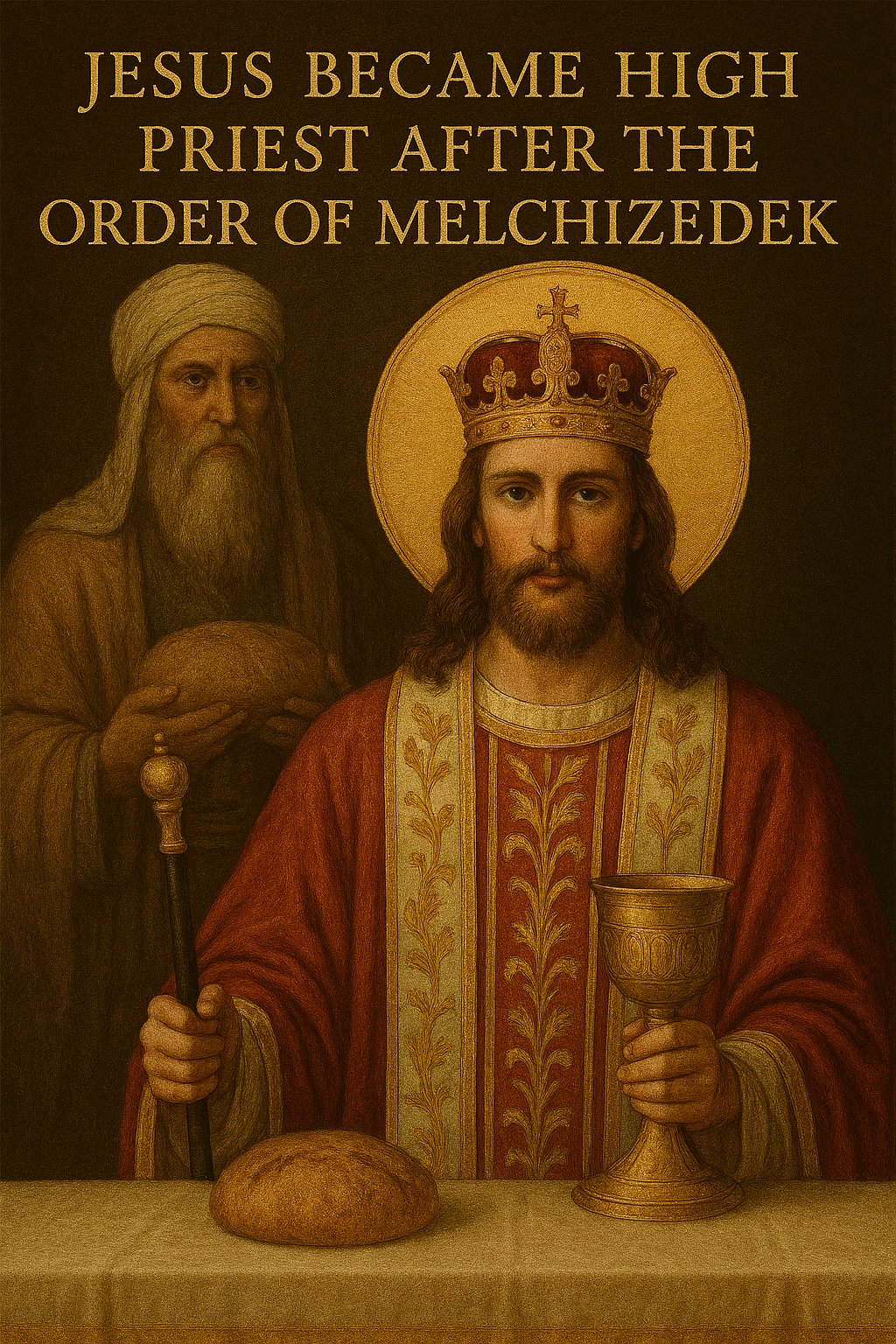
Just these two scriptures alone verify that Jesus, as the Messiah, is a priest forever - after the order of Melchizedek, as God set it up in the beginning with Abraham.
7 who, in the days of His flesh, when He had offered up prayers and supplications, with vehement cries and tears to Him who was able to save Him from death, and was heard because of His godly fear, 8 though He was a Son, yet He learned obedience by the things which He suffered.
When Jesus walked the earth before His crucifixion, He continuously prayed to His Father God with cries and tears for His people. His prayers continued even to the Garden of Gethsemene where Jesus cried tears of blood to release Him from the horrors of suffering crucifixion on the cross for the sins of mankind, whom God could have delivered Him. God, however, sent Jesus to earth for the purpose of becoming the sacrifice for the sins of mankind, and in those agonizing hours of prayer, Jesus submitted to His Father by saying: "not my will, but Your will be done O Lord. In that, Jesus obeyed and suffered the pangs of crucifixion as He laid on the cross as a sacrifice for the sins of the world.
- When Jesus walked in the flesh before His crucifixion, He was tempted like all of us; however, as God, He did not submit to its temptation. In His crucifixion, In His crucifixion, He was obedient to His Father - even unto death. It was there where He learned the totality of what mankind suffers so that He could fully understand the pain that we, as humanity, endure.
9 And having been perfected, He became the author of eternal salvation to all who obey Him, 10 called by God as High Priest “according to the order of Melchizedek,” 11 of whom we have much to say, and hard to explain, since you have become dull of hearing.
When Christ reached His goal of purpose, submission and obedience, He then became the author of mankind's eternal salvation - those who would follow after Him. As such, God then called Jesus to be their High Priest according to the order of Melchizedek - just as God originally created a high priest to be.
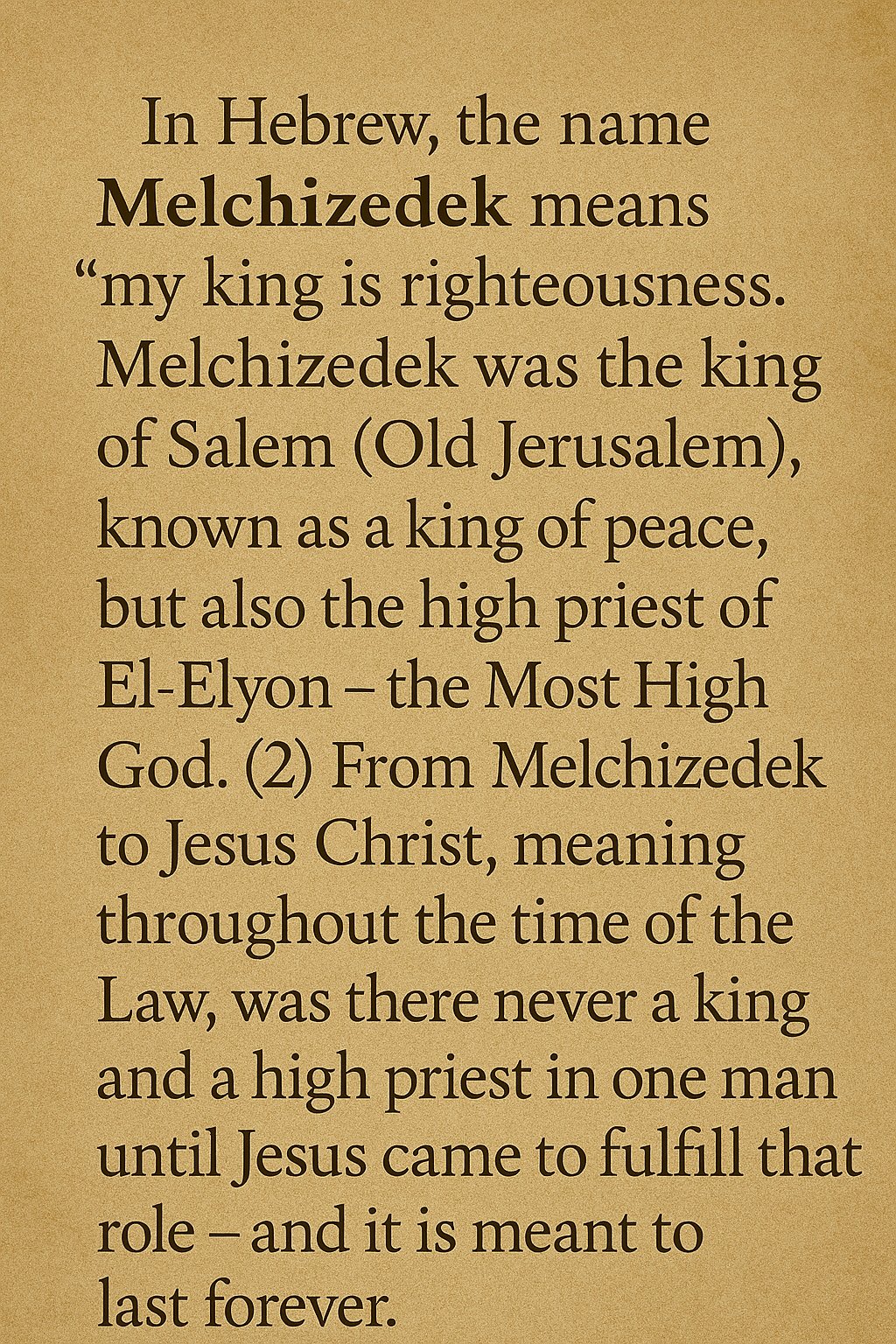
As we continue to learn about Melchizedek, and how Jesus became High Priest after the order of Melchizedek, we are starting to see the similarities between Melchizedek and Jesus. While the mysteries of Melchizedek begin to unravel, we begin to understand Jesus and what He has done for us in a more spiritually mature way and the more He resembles Melchizedek.
Spiritual Immaturity
12 For though by this time you ought to be teachers, you need someone to teach you again the first principles of the oracles of God; and you have come to need milk and not solid food. 13 For everyone who partakes only of milk is unskilled in the word of righteousness, for he is a babe. 14 But solid food belongs to those who are of full age, that is, those who by reason of use have their senses exercised to discern both good and evil.
The author is now chastising his Jewish audience as being babies in the Word of God, whereas they should have known and understood its meaning. As a Jew, they already knew the Torah (meaning the writings of Moses) from memory. All Jewish boys were instructed at their local synogogue from the age of five until the age of fourteen to memorize the Torah. Sadly, most of what they learned became rote memorization mixed in with the practice of the Law. The writings of the prophets, although not memorized was well familar to them, which foretold of the coming of their Messiah. As time progressed, the Law and its leaders became extremely rigid and corrupt, with more emphasis put upon the Law, which only brought Jews to treat any sort of faith as a religion instead of a relationship with God. For these Jews who had become believers in Jesus, they were mixing Jesus in with the Law and all of its practices, and that came against the preaching and teachings of Christ.
The New Testament had not been written at this point of time. There were a few written letters out there from the apostles of Jesus, but most Jewish believers only had the Old Covenant Scriptures (Greek Septuagint - LXX) to rely upon at this time.
While these Jewish believers had come to believe in Jesus as their Messiah, they were ignorant of a lot of His teachings - of His love and righteousness without the Law. The author of Hebrews is claiming these Jewish believers still needed to be suckled on the milk of the Word of God. They knew the Torah from memory, but they were just words taken from memory. They were well versed in the writings of the prophets, knowing their Messiah would be coming. Now that He had come, and they accepted Him, they still continued on with practicing the Law and its rituals as a religious part of their life. That was not what Jesus had taught them.
As such, the author felt it necessary to give them some elementary teachings of Christ and how He has set them (and us) free from the Law and its practices. It was important that they see the Law and its leaders had become rigid and corrupt and were not a part of the teachings of Christ. After they understood, and as they would grow deeper in their faith in Christ, they could then go to more solid food (deeper teachings) as faith deepens and obedience to that faith (not the Law) becomes joined together as their relationship deepens with Christ. Jesus said it so plainly in Matt 22:37-40:
Matt 22:37-40 Jesus said to him, “‘You shall love the Lord your God with all your heart, with all your soul, and with all your mind.’ 38 This is the first and great commandment. 39 And the second is like it: ‘You shall love your neighbor as yourself.’ 40 On these two commandments hang all the Law and the Prophets.”
Sadly, there are believers even today who think that the appearance of obedience to the Word of God is spiritual maturity, being done without faith, meaning trusting and relying upon Jesus as the author and finisher of their faith. Faith and obedience to that faith need to run hand-in-hand. When a believer operates out of that kind of faith, obedience to God and His Word should naturally flow together.
Even today, there are believers in Christ who lean upon the practices of their denomination, treating them as Law. That simply is the appearance of obedience, claiming spiritual maturity - done without complete trust and relying upon Jesus. In this, they are no better than those who claimed belief in Jesus in the 1st century who continued to practice the Law as part of their religion.
Today, we have our Bibles in which we have the teachings of Christ and His disciples readily accessible to us 24/7
- From the Books of Matthew, Mark, Luke, and John, the local church is meant to be a vessel to bring forth Jesus' teachings through the Gospels to teach us what Jesus is saying to His believers.
- From the Book of Acts to Revelation, the local church is meant to be the vessel in bring forth the writings of Jesus' eye-witnesses - His disciples to give us instruction how we, as the Body of Christ, should practice and obey.
- Various church laws and practices are not part of Scripture, of which we need to not follow as any sort of law.
- Remember, our faith in Jesus should be a relationship with Christ, not a religion of church laws.
I am not dimishing the Old Testament which gives us the foundational teachings of God and His righteousness. For that time, the Law was how God brought His Word to His people on how to love God and follow after Him until Jesus came. Throughout time, the Law and its leaders grew into a religion full of rigid laws, and had become corrupt. That was never what God wanted for His people. God has desires a relationship with Him - not a religion of dead works.
(1) The Choice of the High Priest
(2) Genesis 14:18 The Complete Jewish Bible
Remain faithful,


Written by Pastor Joyce A. Erickson
Believers Bible School, Founder https://believersbibleschool.com/