Hebrews - chapter 11 The faith of our spiritual fathers


The Epistle of
Hebrews
Chapter 11
What is faith
Hebrews 11:1 Now faith is the substance of things hoped for, the evidence of things not seen.
Another word for "faith" is "trust." The Greek meaning here is being confident, which gives "present reality to what we hope for." This then is our firm foundation on all that we believe about God and His faithfulness toward His children.
This chapter is often considered by many as the "faith chapter of the Bible," because this whole chapter gives us scriptural evidence of many spiritual heroes of the Bible who held onto their faith in God regardless of circumstances, and what God has done for those who follow after Him.

2 For by it the elders obtained a good testimony.
Our spiritual heroes of the Bible are given for us as encouragement so that we too can trust in the Lord in what we are going through.
3. By faith we understand that the worlds were framed by the word of God, so that the things which are seen were not made of things which are visible.

Athiestic and materialistic scientists have tried to gives us their theory that this world came about some 15 billion years ago by a big bang. Suddenly, some big explosion came about in space where the concent of time and matter are mathematically and physically undefined. That, however, is a lie and violates what God tells us in His Word. By faith, as believers in Him, we have trusted God's Word when we read that in the beginning, from the dawn of creation, God formed the heavens and the earth simply by the command of His voice. We see the trees and flowers around us, the majesticness of the oceans, and even the dirt and rocks we walk on, and we simply know by faith that God brought it into existence from nothing.
4 By faith Abel offered to God a more excellent sacrifice than Cain, through which he obtained witness that he was righteous, God testifying of his gifts; and through it he being dead still speaks.
By faith, we have read and believed that Cain and his brother Abel each gave an offering to God and God rejected Cain's offering of grain, whereas He accepted Abel's offering of a blood sacrifice.
- We've read that Abel, being a righteous man, gave a blood sacrifice of an animal, knowing that his offering was pleasing to God.
- Our Bibles make no mention of Cain being a righteous man - simply that he gave an offering to God. Was it out of obligation or from the heart? That we do not know.
- God, however, only accepted Abel's offering, which created hate and jealousy in Cain.
- As a result, Cain killed his brother.
- Even today, the blood of Able still speaks to us, because the life is in the blood.
Cain did learn that God was not pleased and he could have repented before God. In that, God would have been pleased. Instead, Cain killed his brother out of hatred and jealousy.
- His heart and the act of murder was most definitely sinful and displeasing to God.
- For that, Cain was punished by God.
By faith we believe this Bible example because the Word of God tells us it is true. So then, by faith we trust what happened with Cain and Able actually happened just as God's Word tells us. Can that be an encouragement to us on God's faithfulness to honor His Word?
Enoch's faith in God
5 By faith Enoch was taken away so that he did not see death, “and was not found, because God had taken him;” for before he was taken he had this testimony, that he pleased God.
Enoch was a righteousness man who lived his life by faith in God. He may have been the only righteous man in his generation, for he is the only man listed to be righteous in the sight of God. While he was alive during Adam's lifetime, God raptured Enoch to heaven shortly after Adam's death. We know that Enoch pleased God because there is reliable record of his righteousness, his sudden disappearance, and God rapturing him even outside of God's written Word.
- By his life of faith, Enoch escaped death completely. We know this on reliable testimony that before he was raptured into heaven, his life was pleasing to God.
6 But without faith it is impossible to please Him, for he who comes to God must believe that He is, and that He is a rewarder of those who diligently seek Him.
This is a verse that speaks not only for Enoch, but for all of us - even today. Apart from faith, how can any of us even think we can approach God. We must believe that God not only exists, but that He rewards those who diligently seek Him. That takes heart faith, not just a head knowledge.
- So then, we can each ask ourselves, first of all, do we believe that God exists and is God?
- Then do we believe in our heart that He rewards those who diligently seek after Him and His ways?
- If so, who wouldn't want to be rewarded by God?
- All we have to do is believe in our heart that He will reward us when we sincerely seek Him, believing our rewards are forthcoming, and that He loves to reward us fo our faithfulness to Him.
Glory to God, how blessed we are that the God Who created the heavens and the earth loves and cares for each of us that much to where He genuinely wants to reward us for our faithfulness to Him.
Noah's faith in God
7 By faith Noah, being divinely warned of things not yet seen, moved with godly fear, prepared an ark for the saving of his household, by which he condemned the world and became heir of the righteousness which is according to faith.
Noah was warned by God that a great flood was about to come upon the earth and cover over all dry land because God was angry at the people for not trusting in Him. Think about this:
- Noah didn't even know what it meant to have water come out of the sky, let alone flood the whole earth. Rain had never fallen upon the earth until the time of the flood. The whole human race would drown and be annihilated.
- Then God told Noah to build an ark, and God gave him exact instructions with measurements and that it would take 120 years to build it.
- How was Noah going to convince his wife and adult sons that he heard from God and what must be done to save himself and his family?
- We learn from Genesis that Noah was a man of righteousness, and that he had a relationship with God and was a preacher of righteousness. Now God gave Noah the momumental task of taking the next 120 years to build an ark in the middle of the desert while preaching to everyone around him to repent, for God was about to bring a flood to those who refuse to follow after Him. Noah had to be the laughing stock of everyone around him.
Yet, Noah was faithful to God, even through persecution of everyone around him. But Noah had an intimate fellowship with God who strengthened him in the midst of ridicule and persecution. As a result of this kind of trust in God, God rewarded Noah for his faithfulness, and he and his family were saved and the rest of the world died in the flood. That took a huge amount of faith.
I ask: Do "you" have that kind of faith in God?
But then I ask of myself: Do "I" have that same kind of faith in God?
Abraham's faith in God
8 By faith Abraham obeyed when he was called to go out to the place which he would receive as an inheritance. And he went out, not knowing where he was going. 9 By faith he dwelt in the land of promise as in a foreign country, dwelling in tents with Isaac and Jacob, the heirs with him of the same promise; 10 for he waited for the city which has foundations, whose builder and maker is God.
God is continuously looking for a man of faith who will be obedient to God's call upon his life. He found faith in Abram, later called Abraham in the pagan land of the Chaldeans. God called him to leave his country and go to a land promised to him as his inheritance. As an act of faith, trusting what God told him, Abraham said yes to God having no idea where he would be going. He uprooted his home, taking his wife Sarai, father Teran and nephew Lot and his wife and left on foot into uncharted territory to find that land God promised to him as his inheritance.
Living in tents as temporary dwellings, Abraham and his family eventually came to the land in which God promised. There he continued to live like a foreigner, still dwelling in tents, believing he was looking for a city with an eternal foundation, built by God. Abraham passed this same promise of God on this his son Isaac and Isaac passed it on to his son Jacob as they all continued to live in tents.
11 By faith Sarah herself also received strength to conceive seed, and she bore a child when she was past the age, because she judged Him faithful who had promised. 12 Therefore from one man, and him as good as dead, were born as many as the stars of the sky in multitude—innumerable as the sand which is by the seashore.
Building on the faith in God through Abraham, his wife Sarai, as an old woman was able to conceive. At the age of 90, after waiting for 25 years after God's promise of an heir, Sarai, later called Sarah, who had been barren, bore Isaac.
Abraham was 100 years old when Isaac was born. As an old man, his dead shriveled up loins became potent to father a son, which continued through the generations to millions of people like the stars in the sky or the sands on the seashore.
The heavenly hope
13 These all died in faith, not having received the promises, but having seen them afar off tttwere assured of them, embraced them and confessed that they were strangers and pilgrims on the earth. 14 For those who say such things declare plainly that they seek a homeland. 15 And truly if they had called to mind that country from which they had come out, they would have had opportunity to return. 16 But now they desire a better, that is, a heavenly country. Therefore God is not ashamed to be called their God, for He has prepared a city for them.

Each of these people of faith died not having experienced God's promise of a country to call their own, yet they still believed. They remained steadfast in their faith and trust in God, seeing afar a heavenly homeland. They accepted the fact that they were foreigners and nomads here on earth and looked for a better home - their heavenly fatherland. That is why God is not ashamed to be called their God, for He has prepared for them a heavenly city.
The Faith of the Patriarchs
17 By faith Abraham, when he was tested, offered up Isaac, and he who had received the promises offered up his only begotten son, 18 of whom it was said, “In Isaac your seed shall be called,” 19 concluding that God was able to raise him up, even from the dead, from which he also received him in a figurative sense.
Even after God miraculously brought Isaac into the world, God later tested Abraham, asking him to offer Isaac as a sacrifice back to Him. God had earlier covenanted with Abraham promising him his descendants will come from Isaac. Abraham reasoned that if Isaac died, God would then bring him back to life again after the sacrifice. Abraham's faith in God remained as he continued to believe and trusted God that He would fulfill His promise to him of an heir.
- We know that God provided a ram in the bushes to replace Isaac's sacrifice. Isaac was spared and Abraham proved himself faithful to the Lord.
20 By faith Isaac blessed Jacob and Esau concerning things to come.
To incure a blessing on to a child meant the passing of one's inheritance, similar to a last will and testament, yet a whole lot more. Abraham passed all that he believed in onto Isaac, meaning his worldly possessions, rights and privileges, his morals, values, belief in God, and convictions, as well as his hope for an eternal home with God. It was generally done with the eldest son shortly before the father's death. The son, in turn, would do the same for his son or sons. That way, the father's inheritance could be passed on down from generation to generation. Isaac then laid hands upon Jacob as a blessing of a father's inheritance instead of Esau, who was the eldest son; however, God designed that Jacob was the one who was to receive the blessing (Gen 27).
21 By faith Jacob, when he was dying, blessed each of the sons of Joseph, and worshiped, leaning on the top of his staff.
Again, in faith, Jacob as a dying old man, leaned on his walking stick and laid his hands upon his son Joseph's two sons Manasseh and Ephraim as a blessing of inheritance. There he prayed in faith an inheritance blessing to pass on down to his grandsons.
- Again, this inheritance wasnt just his physical possessions, for Jacob had very little in comparison to Joseph who served in the courts of Pharoah. More to the point Jacob passed his values, morals, convictions, rights and authority and his hope for an eternal inheritance of a heavenly home.
- To do so, Jacob had to have time to pour into their lives to have an influence on Joseph and his sons (his grandsons) while in Egypt.
22 By faith Joseph, when he was dying, made mention of the departure of the children of Israel, and gave instructions concerning his bones.
Joseph, carrying on the faith of his father, looked into the future, knowing his bones needed to rest in the land which God had given to Abraham and his heirs. That meant he had the faith of his father and he knew his family would be leaving Egypt one day and wanted his bones to be laid to rest in their promised land.
The faith of Moses
23 By faith Moses, when he was born, was hidden three months by his parents, because they saw he was a beautiful child; and they were not afraid of the king’s command. 24 By faith Moses, when he became of age, refused to be called the son of Pharaoh’s daughter, 25 choosing rather to suffer affliction with the people of God than to enjoy the passing pleasures of sin, 26 esteeming the reproach of Christ greater riches than the treasures in Egypt; for he looked to the reward. 27 By faith he forsook Egypt, not fearing the wrath of the king; for he endured as seeing Him who is invisible. 28 By faith he kept the Passover and the sprinkling of blood, lest he who destroyed the firstborn should touch them. 29 By faith they passed through the Red Sea as by dry land, whereas the Egyptians, attempting to do so, were drowned.

|
Over 400 years had passed where the Israelites had become slaves to the Egyptian Pharoah. The Pharaoh decreed an edict (law) during this time of Israel's bondage that all male babies were to be drowned in the Nile River. It came out of fear of the growing Hebrew population and hthe Pharoah's attempt to suppress the Israelites potential threat to Egyptian dominance. This decree set the stage for the birth and early life of Moses, the deliverer of Israel. In spite of living in slavery, the faith and heritage of the fathers continued to be passed down to their children and children's children.
Moses was born to an Israelite couple out of the Tribe of Levi while in bondage to the Egyptians. Out of fear for their baby's life, and the divine providence of God, Moses was discovered by the Pharoah's daughter floating in a basket on the Nile River while she was bathing in the river near the castle. Being barren, the Pharoah's daughter took him in and raised him as her son. Through divine providence, the mother of Moses continued prolong nursing him until Moses was old enough to be completely raised by the Pharoah's daughter. It was during this time that Moses' biological mother instilled within her son his heritage. As a result, Moses had the best education under Egyptian royalty, but never left the heritage of his father.
...By faith Moses, when he became of age, refused to be called the son of Pharaoh’s daughter, 25 choosing rather to suffer affliction with the people of God than to enjoy the passing pleasures of sin esteeming the reproach of Christ greater riches than the treasures in Egypt; for he looked to the reward. By faith he forsook Egypt, not fearing the wrath of the king; for he endured as seeing Him who is invisible.
As Moses grew well into adulthood, he chose to live in the faith of his fathers, refused the upbringing of the Egyptian ways. He had the faith to believe in an eternal home with God, knowing that their Messiah would be coming one day to set them free not only of their oppression of the Egyptians, but provide a heavenly home with God in heaven. As a result, Moses made the decision to share in the oppression of his people instead on enjoying the pleasures of life that his opulent living as an Egyptian afforded him.
...By faith he kept the Passover and the sprinkling of blood, lest he who destroyed the firstborn should touch them...
Another forty years had passed where God had sent Moses out of Egypt only to come back under God's divine intervention, to set the Israelites free from their Egyptian bondage. Under instruction of God, Moses did divine miracles on behalf of God, causing great harm to the Egyptians. On the tenth command, Moses called his people to observe the Passover and sprinkle the blood of an animal on their doorpost to avoid God's punishment on the Egyptians of the killing of the first-born son. This last punishment that God gave to the Egyptians caused the Pharoah to release the Israelites to go off into the desert to worship their God. This was their escape from bondage from the Egyptians.
...By faith they passed through the Red Sea as by dry land, whereas the Egyptians, attempting to do so, were drowned...
 After the Egyptians realized ther Israelite were escaping Egypt, a large team os chariots chased after them and found them on the shores of the Red Sea. Moses, by faith in God, God pared the waters and opened up the sea for the six million Israelites to walk through to the other side. God caused a wind to hold back the chariots until all the Israelites had crossed onto dry land. followed by chariots of soldiers. The Egyptian chariots of soldiers tore across the floor of the sea and God closed the sea and they all drowned, freeing the Israelites from their bondage in Egypt.
|
The faith of God' people under the Old Covenant
Hebrews 11:30 By faith the walls of Jericho fell down after they were encircled for seven days. 31 By faith the harlot Rahab did not perish with those who did not believe when she had received the spies with peace.
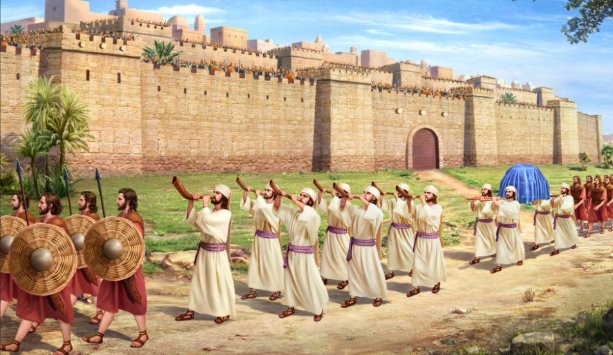
Forty years had passed and a new generation of Israelites were ready to battle ghe Canaanits to conquer the land in which God had promised them. Moses, and now Joshua, keeps counting events of faith where God created miracles to those who believed in Him. The city walls of 32-40 feet high fell down after the Israelite encircled the city for seven days. When Joshua blew his horn, the walls fell down enabling the Israelites to overtake the city of Jericho in triumph as the entered their promised land.
When spying out the city of Jericho, Rahab the harlot and inn owner allowed hiding space for the Israelites. As a result, she did not perish when the Israelites conquered Jericho. She believed in them and their God, and she ended up being part of the lineage of King David and the Messiah to come.
32 And what more shall I say? For the time would fail me to tell of Gideon and Barak and Samson and Jephthah, also of David and Samuel and the prophets: 33 who through faith subdued kingdoms, worked righteousness, obtained promises, stopped the mouths of lions, 34 quenched the violence of fire, escaped the edge of the sword, out of weakness were made strong, became valiant in battle, turned to flight the armies of the aliens. 35 Women received their dead raised to life again. Others were tortured, not accepting deliverance, that they might obtain a better resurrection. 36 Still others had trial of mockings and scourgings, yes, and of chains and imprisonment. 37 They were stoned, they were sawn in two, were tempted, were slain with the sword. They wandered about in sheepskins and goatskins, being destitute, afflicted, tormented— 38 of whom the world was not worthy. They wandered in deserts and mountains, in dens and caves of the earth.
We could go on and on recounting the stories of the faith of our forefathers under the Old Covenant. There was the faith of Gideon, Barak, Samson, Jephthah, David, Samuel and all the prophets.
- Some, through faith were conquerors, overthrowing kingdoms, ruling with justice to receive what God was promising them.
- Some shut the mouths of lions, quenching the flames of fire, escaping the edge of swords,
- God turning weakness into strength, being mighty in battle.
- Others were raised from the dead while others died in their faith, often bring beaten to death, knowing they would be resurrected on the last day.
- Still others were mocked and whipped, chained and imprisoned for their faith.
- Some were stones, sawed in two, murdered by the sword, destitute, persecuted and mistreated.
- Some wandering around in deserts and mountains without a home, living in caves and hole in the ground.
Yet, all of these people stood on their faith, gaining a good reputation in the eyes of God because of their faith. Each one of them received the promise of God for a better home - an eternal heavenly home with their God.
39 And all these, having obtained a good testimony through faith, did not receive the promise, 40 God having provided something better for us, that they should not be made perfect apart from us.
Because of their faith, everyone, regardless of what they endured, has obtained a good testimony through their faith. They did not receive their promise in this life, but God had a better plan in store for each on of them - the promise on eternal life with God forevermore in their heavenly home.
Just as God had something so special in store for the faithful throughout the Old Covenant, God has his special eternal rewards for us under the New Covenant who remain faithful to God regardless of the circumstances we find ourselves in.
- The message here is to remainful faithful in all circumstances because God's promise to us is an eternal reward with Him forever and ever in our heavenly home.
God is faithful - so be faithful to Him.

Written by Pastor Joyce A. Erickson
Believers Bible School, Founder https://believersbibleschool.com/