Colossians - Introduction This letter was sent to confront a cultic heresy that had entered into the church at Colossea

The Epistle to the Colossians

Introduction

In order to understand the full content of the letter that the Apostle Paul wroter to the Colossian church, an understanding of the Colossian Heresy as well as a prelimary study on the Book of Philemon is necessary to fully understand this book of the Bible. As such, this introduction will include pertinent information on both the books of Colossians and Philemon. As in a quality introductory study on any book of the Bible, we will look at the who, what, when, where and why this book was written.

The City of Colossae

The small city of Colossae was an ancient city located in the region of Phrygia in the Roman province of Asia Minor, which is our present-day Turkey.  It was located about 100 miles up into the mountains from Ephesus, which was a large metropolitan trade city on the coastal port on the Aegean Sea. Colossea, as part of a tri-city area that included Laodicea and Hierapolis, was situated near the Lycus River, a tributary of the Meander River, which was very windy as it traveled down the mountain into the Aegean Sea.

The small city of Colossae was about 100 miles up into the mountains from the coastal city of Ephesus - a large metropolitan port city off the Aegean Sea in Phyrgia in Asia Minor. Within the mountains there was a flat area called the Lycus Valley where two rivers met that flowed into a larger river (Meander River) that winded around, flowing down from the mountains and into the Aegean Sea. Three cities dwelt in the Lycus Valley along these two rivers - Hieropolis, Laodecea and Colossea. Because Colossae was further away from the river, it declined over the years and today is nothing but a large hill today with a few ruins laying in heaps. Laodecea also declined and is no longer inhabitated. Hieropolis, however, is known for its miracle pools and a beautiful site to see, as I visited that area a few years ago.

Background of the Church in Colossae

A young man named Epaphras from Colossae was in Ephesus during the three-year ministry of the Apostle Paul (Acts 19). Upon his conversion to Christ, Epaphras traveled back home up in the mountains of the Lycus Valley to his home in Colossae to start a church of his own as an effort to share the Gospel with his friends and family. The Bible is unclear as to whether Epaphras became the pastor of that church. Either way, he was highly influential in Christianity entering into Colossae. 

The Colossian Heresy

Colossae’s mixed population of Jews, but mostly Gentiles manifested itself both in the development of the church, but sadly, several years later a heresy developed within the church, which began mixing Christianity with elements of Jewish legalism, pagan gods and mysticism, which brought about the worship of spiritual angels, and man-made efforts to reach God. Along with being intertwined with the religious philosophy of Gnosticism that was already emerging on the scene, which also had its own set of beliefs and practices, this conglomerated heresy became known as the Colossae heresy.

The danger of mixing cultures into one faith is a challenge because certain cultures have its own religion or philosophy that the people live by. When the Gospel first came to Colossae through Epaphras, it was pure in its origin. As time progressed, however, various belief systems began to enter into the church at Colossae. The Jewish believers brought some of their legalism from Judaism in, while the Gentile pagan carried some of the pagan god worship in, which brought about the worship of spiritual angels. Gnosticism was also on the rise that was already twisting Christianity, which all of them together became the foundation of the Colossian Heresy.

Let's begin first by looking at Gnosticism. 

  • Gnosticism was and still is a belief that God is good, but matter is evil.
  • Jesus Christ was not a physical human being, but only came in the spirit. Those then who claim they saw Jesus in the flesh was then told it was a mirage - a figment of one's imagination. - denying Jesus' true humanity.
  • Since Jesus was only a spirit, according to Gnosticism, He could not die "physically," because He was never human. Therefore, His death was not real, thus making our salvation invalid.
  • Thus Gnosticism was born by man creating another way of eternal salvation. It lie in the discovery of finding a secret, higher knowledge within the Scriptures to gain favor, enlightenment and eventual salvation with God forever. 

Along with Gnostic beliefs were also aspects of Jewish legalism, meaning Jewish believers merged the necessity of circumcision as part of reaching salvation, observance of the ceremonial rituals of the OT law (dietary laws, festivals, Sabbaths), and rigid asceticism. Those coming out of paganism brought in the mysticism of their various gods, which mixed with Christianity the worship of the various gods into their new form of Christianity known as the Colossian Heresy. 

The Gospel of Jesus Christ is simply a belief that Jesus as God, came to earth as a human, to suffer the penalty of a physical death, shedding His physical blood on the cross for the forgiveness of our sins. All God asks is that we believe in Who Jesus is and trust in Him for our eternal salvation. 

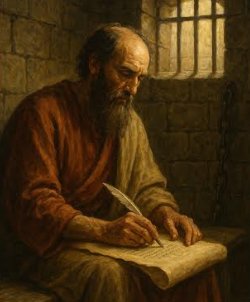
Epaphras was so concerned about this heresy to where in 62 A.D., he made the long journey from Colosse to Rome (Col 4:12-13), where Paul was a prisoner - under house arrest awaiting to stand before Emperor Nero, with hopes of being freed. In response to Epiphras' plea to the apostle, the Apostle Paul wrote this letter to the believers of a church at Colossae warning them against this heresy, and then responded with the truths of God's Word.

Background of the Apostle Paul in Rome

I had the privilege of entering into his (traditional) house arrest home while visiting Rome a few years ago. It was a sobering, awesome experience.

The Apostle Paul had been sentenced to stand before Emperor Nero by his own people of the Sanhedrin Council back in Israel. After a long and lengthy trip to Rome, he was put under house arrest in Rome, being able to have visitors, but chained to a Roman guard for two years. While he was later set free by Emperor Nero, it would be short lived.

While underhouse arrest, many Jews and Gentile Christians visited him. As such, the Apostle Paul was able to continue on in ministry during those two years while confined in chains. 

Paul's house was not merely a place of confinement but a bustling center of Christian activity. He "received all who came in to see him" (Acts 28:30), indicating a constant stream of visitors which allowed him to engage in personal evangelism, discipleship, and pastoral care.

  • Timothy was a great help to Paul and was very instrumental in the writing of this epistle as well as the Epistle to the Ephesians and Philippians, as well as a personal letter to  Philemon, the pastor of the church in Colossea.
  • Aristarchus, who may have been a fellow prisoner with Paul, Demas, along with Mark as his constant companion, who was the cousin of Barnabas and writer of the second gospel spent a great deal of time with him.

As God would design it, during this time under house arrest, a run-a-way slave named Onesimus from Colossae came in contact with the apostle and became born-again. He just happened to be the slave of the present pastor of the church at Colossae. He became a great help to Paul and an asset in his ministry. 

Epaphras arrived in Rome in 62 A.D. looking for the Apostle Paul to somehow reach his people back in Colossae with warnings about the dangers of mixing their faith in Christ Jesus with false teachings and philosophies and return to their faith in Christ Jesus and the true Word of God. This was the background to the writing of the Epistle to the Colossians.

Up to this point, the Apostle Paul had written two letters while in prison - to the church at Ephesus and Philippi, and upon listening to Epaphas was compelled to write a letter of warning and encouragement to the church at Colossea as well. Paul had chosen that Tychicus, his faithful co-worker for Christ who would deliver these letters back to the Lycus Valley in Phyrgia. In addition, Paul wrote a special letter to Philemon, the present pastor of Colossea, whose church was in his house. As only God could arrange it, Philemon was also the slave owner to Onisimus. The apostle wrote of his new friend who was now a faithful witness for Christ, telling him of Onesimus' conversion to Christ and that he would be returning him back to Philemon. He was beseeching Philemon to not only take Onisimus back, but to receive him as a brother in the Lord - not as a slave, for he would be valuable to him in ministry. (Refer to the Book of Philemon for details). 

The Delivery of the Letters

Tychicus left with three letters in hand, along with Onisemus, headed for Colossea. Instructions were to not only read his letter to the Colossians, but to the church at Laodecia as well. In fact, those same instructions were given regarding the letter to the church at Ephesus, and as such, all these letters became circulation letters among the churches throughout the Lycus Valley and down to the coastline city of Ephesus. For us, these letters are a part of the New Testament scriptures to the churches today.

We now enter into chapter 1 of the Epistle to the Colossians.

Blessings,

Click here for chapter 1 of Colossians
Colossians - chapter 1 / Colossians (Epistle) / Bible Study - Old & New Testament / Believers Bible School


Click on book to order through Amazon

Click here for chapter 1 of Colossians
Who is Jesus and what He has done for us? / Colossians (Epistle) / Bible Study - Old & New Testament / Believers Bible School

Written by Pastor Joyce A. Erickson

Believers Bible School, Founder https://believersbibleschool.com/